
Why the World is Actually an Ocean of Waves
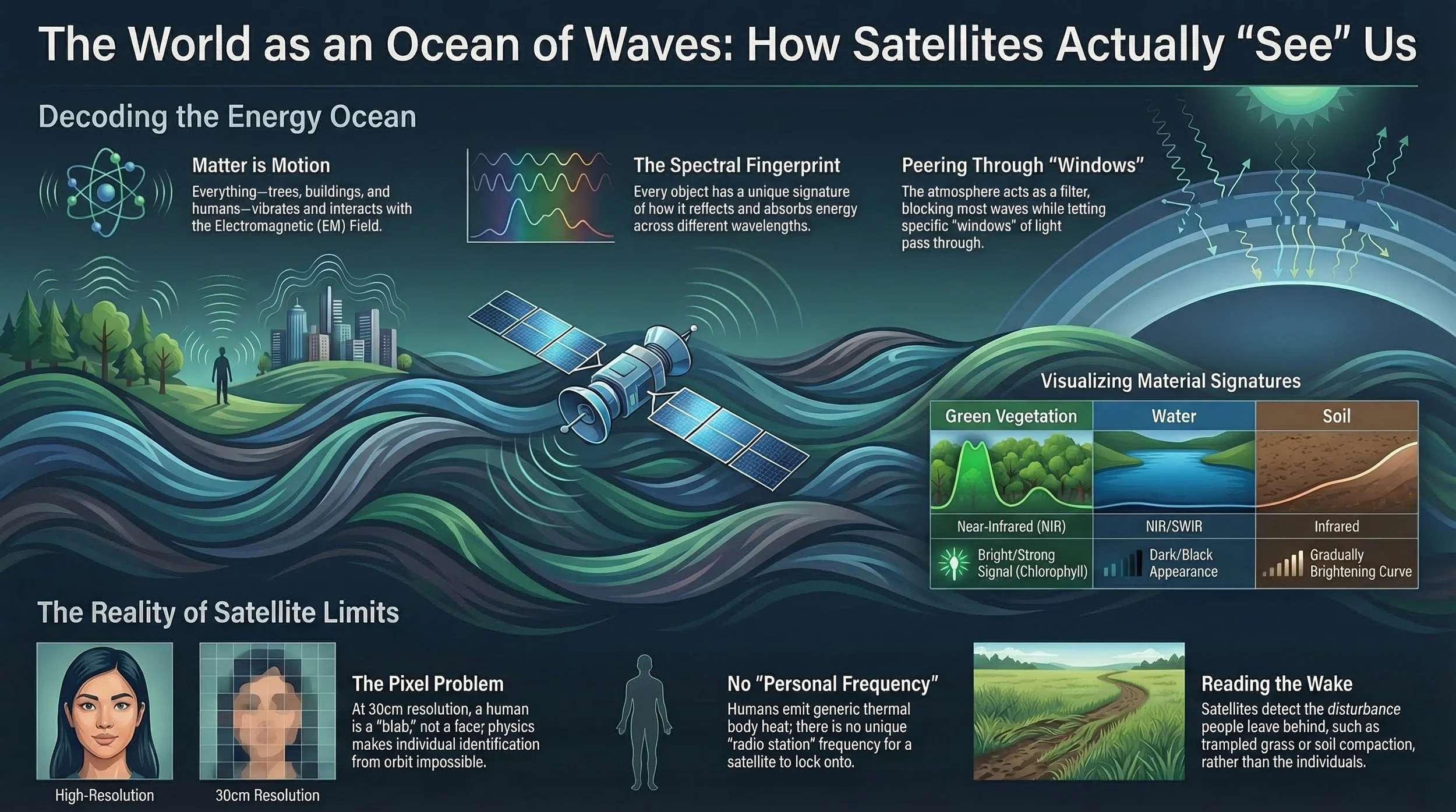
When you look around, you probably see a world made of solid, static objects—trees, buildings, the device you are reading this on. But what if I told you that from space, the Earth looks completely different?
To the satellites orbiting our planet, the world is a dynamic, swirling ocean of energy fields. Every single object on Earth—including you—is constantly vibrating and interacting with the Electromagnetic (EM) Field.
If you want to understand how modern satellites "see" our world, you have to stop thinking about taking a photograph and start thinking about reading the waves of this invisible ocean.
Everything Has an Energy Fingerprint
Just like water moves differently depending on the tides and winds, every object on Earth interacts with electromagnetic energy in its own unique way. This is called a Spectral Signature, and it acts as an object's chemical "fingerprint".
Objects don't just have a color; they have a specific way of reflecting, absorbing, and emitting radiation across different wavelengths. For example, healthy green vegetation reflects a lot of Near-Infrared energy, while water absorbs it and appears entirely dark. By reading these specific energy signatures, scientists can easily tell the difference between a real tree and a camouflaged tank.
Looking Through the "Windows" of the Sky
So, why don't satellites just look at all the energy at once? Because our atmosphere acts like a giant, protective filter. Gases like ozone, carbon dioxide, and water vapor act as "walls," absorbing significant amounts of radiation and creating blind spots for sensors.
Fortunately, there are gaps in this barrier where energy passes straight through. These are called Atmospheric Windows, and engineers specifically design satellite sensors to look through these transparent gaps—mainly in the Visible, Thermal Infrared, and Microwave bands.
The "Ships" Navigating the Energy Ocean
Satellites act as ships floating above this ocean of energy, and they use different tools to navigate the currents.
Passive Optical Sensors (The Looking Glass): These rely on the Sun's reflected energy to measure the "color" and chemistry of the surface, but they become totally blind if clouds roll in or the sun sets.
Thermal Sensors (Tracking the Heat): Because everything above absolute zero emits radiation, these sensors detect the "warmth" of the Earth, allowing them to spot urban heat islands or wildfires even in pitch darkness.
Active Radar (The Sonar): Unlike optical sensors, Radar (SAR) generates its own pulse of energy and listens for the echo that bounces back. This acts like a bat's echolocation, piercing right through clouds, smoke, and dust to measure the physical texture and roughness of the Earth's surface.
Busting the Spy Movie Myth: Do You Have a "Personal Frequency"?
We've all seen movies where a satellite zooms in from space to track a specific person walking down the street. But physics tells a different story.
First, humans do not have a unique "personal frequency" or radio station that a satellite can magically lock onto. While we all emit body heat and reflect light, these signatures are generic to our species, not unique to you as an individual.
Second, satellites are bound by the strict laws of physics, specifically the Diffraction Limit. Commercial satellites are generally limited to seeing pixels that are about 30 centimeters wide. Since a human is roughly half a meter wide, a person from orbit just looks like a tiny, blurry blob, not a recognizable face.
What about tracking your body heat? It turns out the Earth is just too warm and noisy. A human outputs about 100 watts of heat, which is a tiny drop in the bucket compared to the massive heat radiating from the soil and concrete within a single satellite pixel. We can see a whole city heating up, but we cannot see a single person running a fever. Furthermore, when people group together, their electromagnetic signatures simply blend into the background noise through a principle called Superposition.
Reading the Wake, Not the Boat
If satellites can't track us individually, how do we monitor human activity? We look at the wake we leave behind.
Even if the "vessel" (the human) is invisible to the satellite, the environmental footprint is not. Satellites are incredibly good at detecting the traces of our presence:
Trampled vegetation shows up as a measurable change in chlorophyll.
Disturbed soil creates a detectable shift in infrared reflectance.
Ultimately, satellites aren't "watching" us in a creepy, personal sense. Instead, they are measuring the ripples, waves, and patterns we leave behind in the great energy field of our planet.
