
Top 20 GitHub Agents for Scientific Analysis (2026)
Meet Your New Robot Research Assistant: A Beginner’s Guide to AI Research Agents
Imagine having a tireless assistant who can read millions of scientific papers, scour the entire internet for data, and write up a perfectly formatted, highly accurate report—all while you sleep.
A few years ago, this sounded like science fiction. But as of 2026, it is rapidly becoming a reality thanks to a new technology known as AI Research Agents. If you've played around with standard AI chatbots and found yourself wishing they could do more than just answer simple questions, you're going to want to know about this.
Here is a plain-English breakdown of what AI research agents are, what they can do, and why they are changing the way we work.
What is an "AI Research Agent"?
To understand research agents, it helps to look at how far AI has come. In the past, AI tools were mostly passive—you asked a question, and it gave you an answer based on its training. If you wanted data from a website, you had to use basic "web scrapers" that needed to be manually coded by a programmer.
Today, the technology has evolved into what experts call "Deep Research" systems. Instead of just fetching a single web page or answering a quick prompt, these agents act autonomously. You give them a goal, and they can independently generate a hypothesis, explore the web step-by-step, read complex scientific literature, and synthesize everything into a final report.
The Two Flavors of AI Agents
The world of AI research agents is currently divided into two main camps:
1. Commercial Agents (The Polished Professionals) These are built for businesses that need high accuracy and ready-to-use deliverables like presentations or spreadsheets.
Energent.ai, for example, is a top-tier tool that can turn messy PDFs into structured insights, boasting a massive 94.4% accuracy rate on financial analysis tests.
Perplexity AI acts as a "Search-First" agent, giving you live-updating research pages with clearly cited sources.
2. Open-Source Agents (The Frontier Pioneers) These are experimental, freely available tools built by global communities of developers, and they are pushing the boundaries of what AI can do.
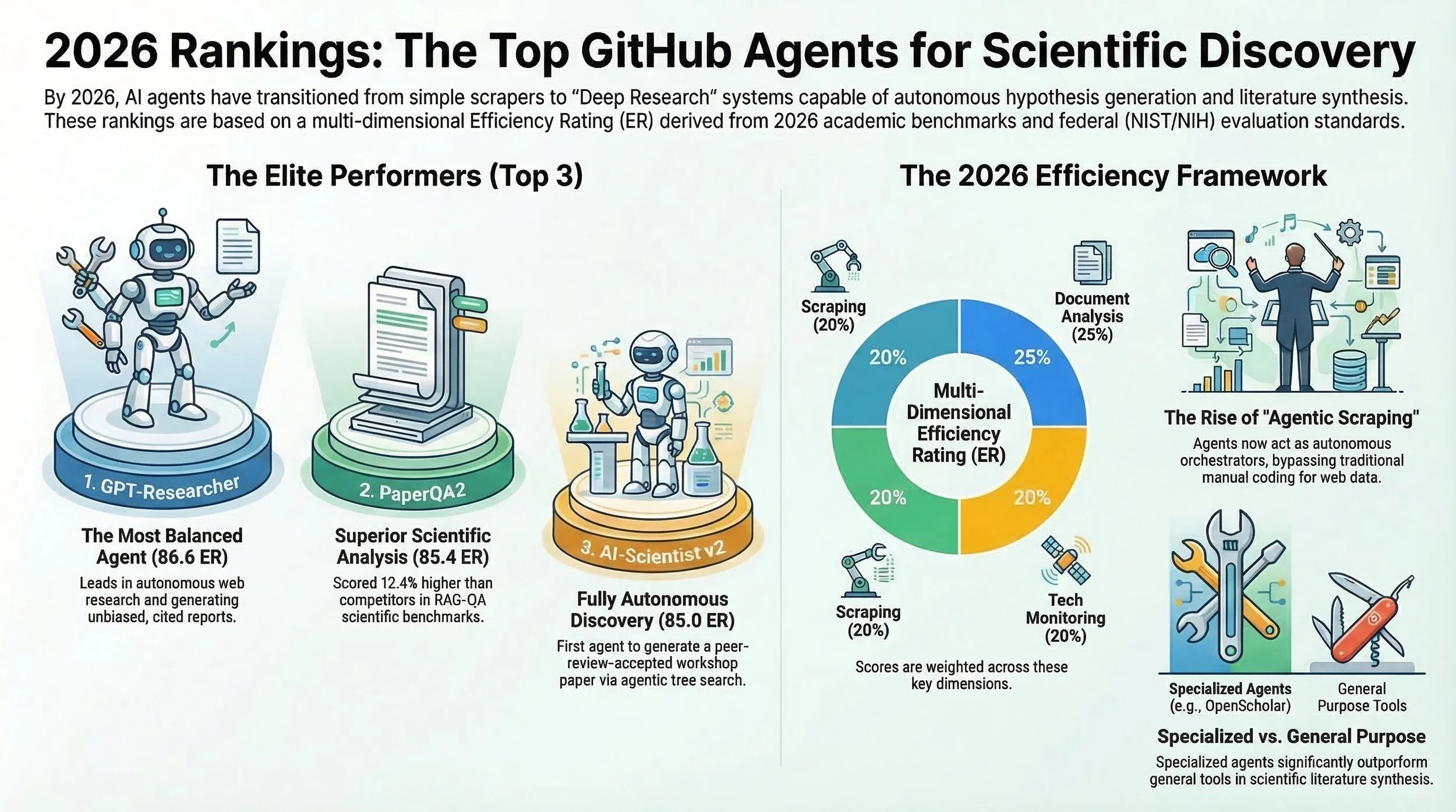
AI-Scientist v2 is a groundbreaking system that can actually automate scientific discovery. It made headlines recently by generating a complete research paper that was good enough to pass human peer review and get accepted into an academic workshop.
GPT-Researcher is currently ranked as the #1 open-source agent for its ability to independently scrape the web and write highly detailed, unbiased reports with precise citations.
How Do They Actually Work?
If you peek under the hood, these agents are essentially juggling a few very complex tasks at once:
Reading and Summarizing: Agents like PaperQA2 are specifically designed to read massive amounts of scientific documents. They can read through full-text databases and write summaries of complex scientific topics that are actually more accurate than those written by humans.
Browsing the Web: Getting information off the internet isn't as easy as it sounds. Agents have to navigate a fragmented web divided into three zones: the "Hostile web" (sites that try to block bots), the "Negotiated web" (sites that require licenses), and the "Invited web" (sites that welcome AI). Tools like Firecrawl specialize in bypassing these hurdles, converting entire websites into clean text for the AI to read.
Acting as the "Hands": Some agents, like OpenHands, act as the physical workers of the research process, successfully writing and executing computer code to solve real-world software problems.
Are Human Researchers Doomed? (The Reality Check)
With AI writing peer-reviewed papers, you might be wondering if scientists and analysts are out of a job. The short answer is: not yet.
Recent academic tests from 2026, like the AIRS-Bench and FIRE-Bench, have given us a sobering reality check. While top AI agents can beat human performance in a handful of very specific tasks, they still fail to match humans in the vast majority of them.
The experts note that "full-cycle scientific research remains challenging" for these systems. When asked to design experiments or use evidence-based reasoning, the agents still make mistakes, experience "recurring failure modes," and show highly inconsistent results.
Furthermore, as these tools become more powerful, the U.S. government is stepping in. The National Institute of Standards and Technology (NIST) is creating new compliance rules to ensure these agents are secure and that their work can be audited and traced back to real facts (to prevent the AI from "hallucinating" or making things up).
The Bottom Line
We are moving away from the era of AI as a simple chatbot and entering the era of AI as a capable, autonomous employee. While they aren't quite ready to replace human scientists entirely, tools like GPT-Researcher and Energent.ai are incredibly powerful assistants that can automate the most tedious parts of research.
Whether you need to monitor new technologies, summarize hundreds of scientific papers, or just figure out how to navigate a mountain of data, there is likely an AI agent ready to get to work for you.
