
A Beginner's Guide to the "Geometric" Operating System
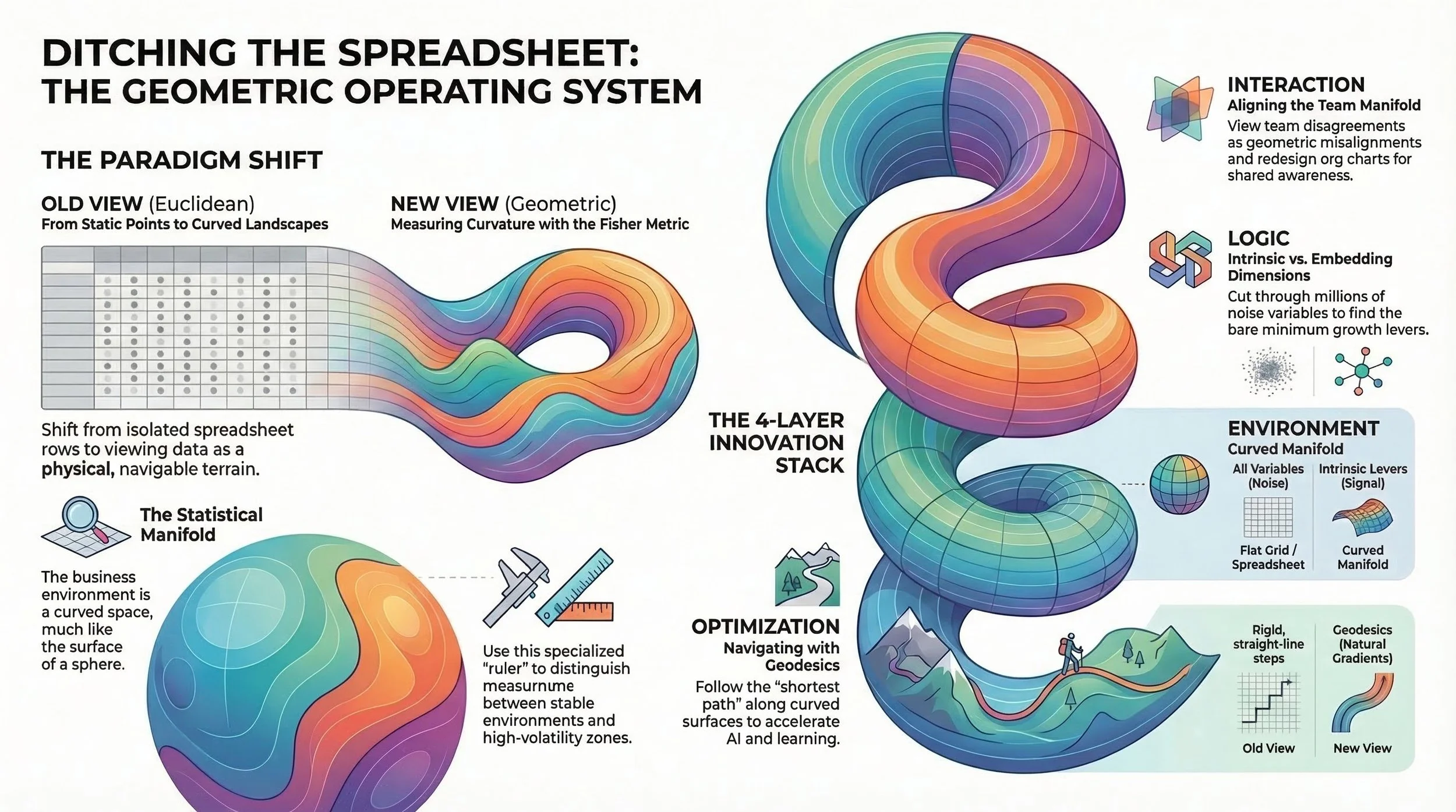
Ditching the Spreadsheet: A Beginner's Guide to the "Geometric" Operating System
When you think of data, what comes to mind? Chances are, you picture the "Old View": static data points trapped in endless rows and columns of a spreadsheet. But what if we completely reimagined how we look at information?
What if data wasn't just a collection of isolated numbers, but a physical, curved landscape that you could actually navigate?
Welcome to the Geometric View.
In a fascinating framework known as the Informational Manifold (or the Info-Geometric Operating System), experts are proposing a radical shift: treating probability and data as physical points in a geometric space. By understanding the "shape" of our data, we can stop guessing and optimizing blindly, and start truly navigating the terrain of our business or technology.
Here is a simplified breakdown of how this Geometric Operating System works, built on a six-layer stack:
1. The Environment (The Substrate)
Imagine the environment your business operates in not as a flat grid, but as a "Statistical Manifold"—a space that might locally look flat but has a massive, global curved structure, much like the surface of a sphere or a donut. In this world, a single data point (like a customer segment) is a specific location, and the collection of all possibilities forms a vast, curved landscape.
2. The Ruler (The Metric)
If you are standing on a curved surface, drawing a straight line isn't always the shortest or safest path—in fact, a straight line might force you into impossible states. To navigate this, we need a new ruler. This framework uses something called the Fisher Information Metric to measure the curvature of your data's landscape. It tells you if a state is highly curved (volatile and hard to distinguish) or low-curvature (stable and easy to distinguish).
3. Signal vs. Noise (The Logic)
Modern companies drown in millions of raw variables, sensors, and market inputs. In geometry, this overwhelming noise is called the "Embedding Dimension". The geometric operating system helps us cut through this noise to find the "Intrinsic Dimension"—the absolute bare minimum number of variables or levers you actually need to pull to move the company forward.
4. The Shortest Path (The Optimization)
Because standard computer algorithms assume the world is flat, they often take rigid steps and get stuck. By embracing the curves of our data, we can find geodesics—the true shortest paths along a curved surface. Instead of forcing a straight Euclidean line against market resistance, we follow the natural geometry of the problem. This allows AI models to train faster and systems to learn more reliably.
5. The Sweet Spot (Stability)
The best systems—including the human brain—operate at a critical sweet spot known as the "edge of differentiability". This is the perfect balancing act between being too rigid (ordered) and too chaotic (random). Operating at this edge ensures that a system can learn new things rapidly while remaining robust enough to resist background noise.
6. Team Alignment (The Interaction)
Perhaps the most fascinating part of this framework is how it applies to human teams. When your team disagrees, it isn't necessarily because someone is being irrational; it is often just a "geometric misalignment". Everyone is projecting their own internal states into a shared space. By treating a team as a "Neural Manifold," we can design the literal geometry of an organization chart to promote shared awareness, reduce friction, and align the team's goals.
Why Does This Matter?
This isn't just a theoretical math exercise; it is a highly transferable framework for high-quality, sustainable growth. Whether you are accelerating AI discovery by compressing complex user data, predicting financial market evolution, or restructuring your company's org chart, this system scales.
By trading our flat spreadsheets for curved geometry, we can finally work with the natural shape of our environments rather than fighting against them.
